Getting Started#
Spin Weighted Spherical Harmonics#
The spin weighted spherical harmonic \({}_s Y_{lm}(\theta)e^{im\phi}\) can be computed using the sphericalY() function. The spin weight \(s\) can be any integer or half-integer value. For a given spin weight, the values of \(l\) and \(m\) must satisfy the following conditions.
Note that the spheroidal library uses the convention that \(\theta\) is the polar angle and \(\phi\) is the azimuthal angle. For more information on spin weighted spherical harmonics, see the Background page.
import spheroidal
from math import pi

s, l, m = -2, 2, 2

Y = spheroidal.sphericalY(s,l,m)

# Evaluate the harmonic at theta = pi/2, phi = 0
Y(pi/2, 0)
(0.15769578262626005+0j)
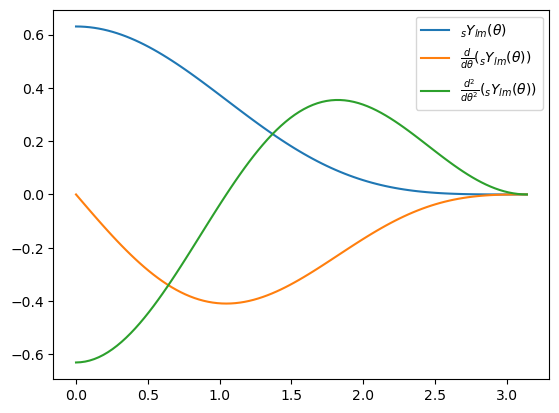
The sphericalY_deriv() and sphericalY_deriv2() functions return the first and second derivative of \({}_s Y_{lm}(\theta)e^{im\phi}\) with respect to \(\theta\).
import matplotlib.pyplot as plt
import numpy as np

dY = spheroidal.sphericalY_deriv(s,l,m)
d2Y = spheroidal.sphericalY_deriv2(s,l,m)

# Plot as a function of theta at phi=0
theta = np.linspace(0,pi,100)
plt.plot(theta, Y(theta,0))
plt.plot(theta, dY(theta,0))
plt.plot(theta, d2Y(theta,0))
plt.legend([r"${}_sY_{lm}(\theta)$",
            r'$\frac{d}{d\theta}\left({}_sY_{lm}(\theta)\right)$',
            r'$\frac{d^2}{d\theta^2}\left({}_sY_{lm}(\theta)\right)$'])

plt.show()
Spheroidal Eigenvalues#
Use the eigenvalue() function to compute the spheroidal eigenvalue \({}_s \lambda_{lm}\) as defined in the equation below.
The spheroidicity \(\gamma\) can be any complex value. It is represented by the variable g in the spheroidal library.
s, l, m, g = -2, 2, 2, 1.5
spheroidal.eigenvalue(s,l,m,g)
-5.577627364678826
The method argument can be set to either "spectral" or "leaver" to specify how the eigenvalue should be computed. If method is set to "spectral", the eigenvalue will be computed using the spherical expansion method. If it is set to "leaver", then Leaver’s method will be used instead. Both methods are described in detail on the Background page. By default, the spherical expansion method is used because Leaver’s method becomes unreliable at high values of \(l\) unless a higher precision is used.
spheroidal.eigenvalue(s,l,m,g,method="leaver")
-5.5776273646788255
Spin Weighted Spheroidal Harmonics#
The harmonic() function returns the spin weighted spheroidal harmonic \({}_s S_{lm}^\gamma(\theta)e^{im\phi}\), where \({}_s S_{lm}^\gamma(\theta)\) is a solution to equation (1).
# compute spheroidal harmonic
S = spheroidal.harmonic(s,l,m,g)

# evaluate at theta=pi/2, phi=0
S(pi/2,0)
(0.06692950919170593+0j)
As with spheroidal eigenvalues, the method argument is set to "spectral" by default, but can be changed to "leaver".
spheroidal.harmonic(s,l,m,g,method="leaver")(pi/2,0)
(0.06692950919170597+0j)
Derivatives#
The harmonic_deriv() function can be used to compute derivatives of spin weighted spheroidal harmonic. By default, this function returns the first derivative with respect to \(\theta\) of \({}_s S_{lm}^\gamma(\theta)e^{im\phi}\) computed using the spherical expansion method.
spheroidal.harmonic_deriv(s,l,m,g)(pi/2,0)
(-0.20852146386265386+0j)
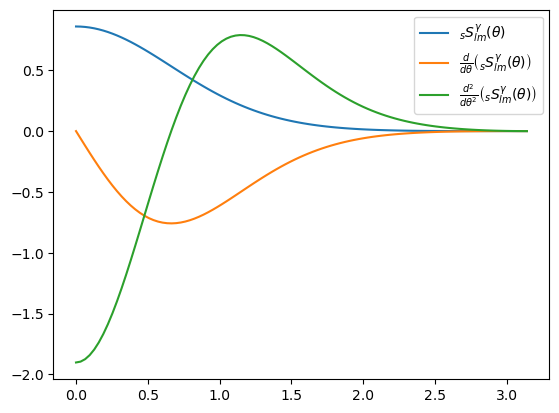
Use n_theta and n_phi to set the number of derivatives with respect to \(\theta\) and \(\phi\) respectively. Currently, only the first two derivatives with respect to \(\theta\) are supported.
spheroidal.harmonic_deriv(s,l,m,g,n_theta=1,n_phi=1)(pi/2,0)
(-0-0.4170429277253077j)
import spheroidal
import numpy as np
import matplotlib.pyplot as plt
from math import pi
s, l, m, g = -2, 2, 2, 1.5

theta = np.linspace(0,pi,100)

S0 = spheroidal.harmonic_deriv(s,l,m,g,n_theta=0)
S1 = spheroidal.harmonic_deriv(s,l,m,g,n_theta=1)
S2 = spheroidal.harmonic_deriv(s,l,m,g,n_theta=2)

plt.plot(theta, S0(theta,0))
plt.plot(theta, S1(theta,0))
plt.plot(theta, S2(theta,0))
plt.legend([r"${}_sS_{lm}^\gamma(\theta)$",
            r"$\frac{d}{d\theta}\left({}_sS_{lm}^\gamma(\theta)\right)$",
            r"$\frac{d^2}{d\theta^2}\left({}_sS_{lm}^\gamma(\theta)\right)$"])

plt.show()